Protecting muscle on a GLP-1: protein, resistance training and body composition
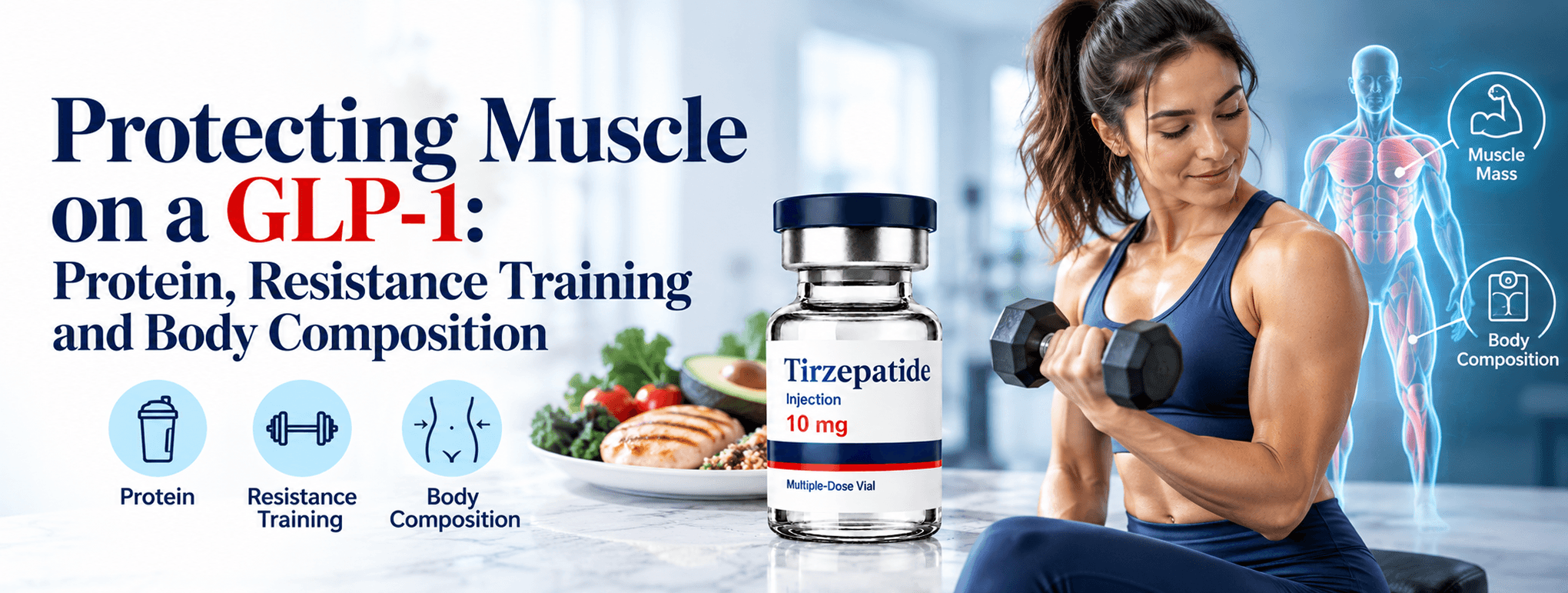
Some of the weight lost on a GLP-1 is lean tissue, not fat. That's true of most rapid weight loss, medication or not. Eating enough protein and doing resistance training two or three times a week are the two habits with the strongest evidence behind them.
Why muscle loss on semaglutide happens at all?
Your body doesn't politely take every pound from fat stores. When energy in drops well below energy out, it draws on whatever is available, and some of that is muscle. This isn't a quirk of GLP-1 medication. It shows up after bariatric surgery, in very-low-calorie diets, and in anyone cutting fast for a weigh-in.
What the medication changes is how easy it becomes to undereat without noticing. The signal that normally nags you at 4pm goes quiet. People tell their provider they "just aren't hungry," and the day's food log comes to 900 calories with about 40 grams of protein in it. That's the setup for lean-mass loss, and the accidental crash diet did it.
Age stacks on top of that. Adults lose muscle gradually from roughly their forties onward, and a hard stretch of weight loss lands on that slope rather than replacing it.
How much of it is muscle? The honest answer
You'll see confident percentages all over social media. Treat them carefully. The figure swings hard depending on how fast the weight came off, how much someone ate, whether they trained, and how the study measured body composition at all. [VERIFY: insert a peer-reviewed lean-mass-fraction figure with citation before publication; do not publish a number without one.]
What isn't in dispute: some of it is lean tissue, and how much is partly in your hands. Two people can lose the same 30 pounds in six months and end up with very different bodies underneath. The one who ate protein and lifted keeps more of their strength.
One clarification, because it trips people up: not all "lean mass" is muscle. Scans count water and glycogen in that bucket, and much of the early drop is water leaving with depleted glycogen. That part comes back.
What the scale can and can't tell you?
1. Bathroom scale: Tells you your total weight and how it changes over weeks. However, it doesn't show the split between fat and lean mass, so muscle loss can be hidden behind a “good” number.
2. Tape measure + how clothes fit: Shows where your body size is decreasing, roughly. However, it can't distinguish fat loss from lean tissue loss in a limb.
3. Body-composition scan (DEXA or a clinic BIA device): Gives you a useful breakdown of fat mass and lean mass that you can repeat every few months. However, it costs money, and BIA readings can vary with hydration, so comparisons should be made under similar conditions.
There's a free proxy most people ignore: your working weights. If you pressed a pair of dumbbells in June and can't move them in September, something changed, and it isn't motivation.
Protein is the part people get wrong
The problem is rarely knowledge. It's appetite. Protein fills you up, the medication fills you up, and the two stack until a chicken breast feels like a chore by the third bite.
A few things that help:
● Eat protein first at every meal. Whatever appetite you have gets spent on the thing that matters most.
● Spread it across the day rather than making it up at dinner. Three moderate servings beat one enormous one you can't finish.
● Lean on soft and liquid sources when solid food is unappealing. On a rough day, a shake you actually drink beats a steak you don't.
● Cook when you feel best, not when you're hungry, because you may not get hungry.
For a target, clinicians work from your body weight and activity level rather than one universal figure. [VERIFY: confirm the protein range The GLP Doctor's clinical team recommends, with citation, before publishing a number here.] Ask your provider or a registered dietitian for yours - and note that in kidney disease protein targets are set differently, so this general advice doesn't apply.
Resistance training: two or three sessions, not a heroic program
You don't need a bodybuilding split. You need to give your muscles a reason to stay.
Two full-body sessions a week covering a push, a pull, a squat or hinge and something for the core does most of the work. Three is better if you have time. The non-negotiable part is effort: the last couple of reps should be genuinely hard. Fifteen reps with a weight you could lift thirty times is a warm-up, not a stimulus.
Try to keep the weight on the bar steady as your body weight drops. Adding load in a deficit is a bonus, not the expectation. If your lifts hold while the scale moves down, that's the win.
Cardio isn't the enemy, but it isn't protective either. Walking is excellent for a hundred other reasons. It won't tell your quadriceps to stay.
Where dose and pace come in?
Faster loss means a bigger deficit, and a bigger deficit usually means more lean tissue in the mix. Some patients raise that as an argument for moving slowly, and it's a fair conversation to have with a prescriber. It's also an individual one. Dose decisions belong to your clinician, not to a guide on the internet.
One structural note, though. Many online programs charge more as your dose climbs, which quietly penalizes anyone who wants to go slowly. The GLP Doctor charges the same $149 a month at any dose, so pace stays a clinical decision rather than a budget one.
Signs worth mentioning to your provider
Persistent weakness, dizziness on standing, hair shedding, feeling cold, routine workouts leaving you flattened for two days. Any of those alongside rapid weight loss is worth raising rather than toughing out. Sometimes the answer is simply more food.
No one can promise you a body-composition outcome, and anyone who does is selling something. What's reasonable is that protein and lifting shift the odds in your favor.
Frequently asked questions
Does semaglutide cause muscle loss? Weight lost quickly is always a mix of fat and lean tissue, and these medications produce weight loss quickly. Whether the drug adds lean-mass loss beyond what the deficit alone would cause is still an open question. The honest answer is we don't know yet with precision.
How much protein do I need? It depends on your weight, your training and your kidney function - a question for your provider or a dietitian, not a fixed number from an article.
Can I build muscle while losing weight on a GLP-1? If you already train, holding what you have is the realistic goal. If you're new to lifting, you may gain strength and a little size early on even in a deficit.
Is the muscle gone for good? No. Lean mass can be rebuilt once weight loss slows, though rebuilding takes longer than losing did. That asymmetry is the reason to protect it now.
Do I need creatine or supplements? Food first. Supplements are a conversation for your provider, particularly if you take other medications.
What about the new oral options? Oral semaglutide 25 mg was FDA-approved on 22 December 2025, and orforglipron (Foundayo) followed on 1 April 2026. The route doesn't change the muscle question. The deficit does.