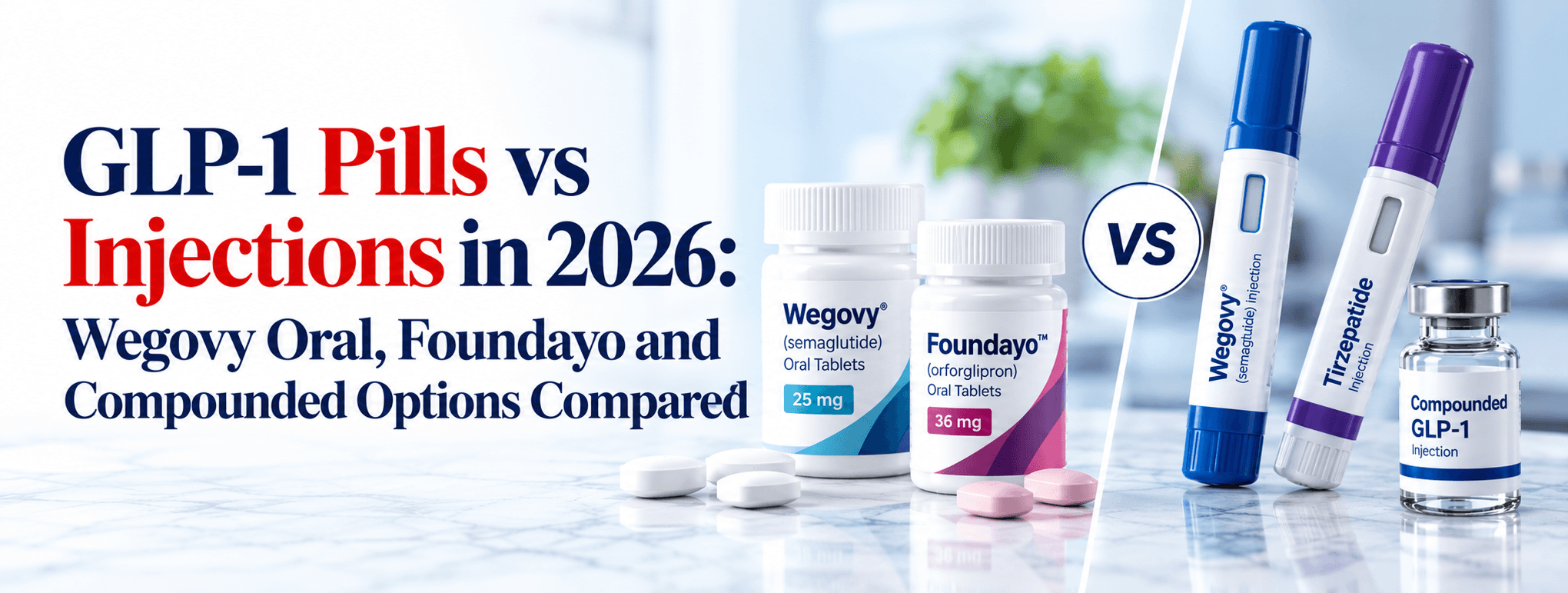
GLP-1 Pills vs Injections in 2026: Wegovy Oral, Foundayo and Compounded Options Compared
GLP-1 pills vs injections in 2026: what changed and who should switch
Two FDA-approved oral GLP-1s now exist: the 25 mg semaglutide tablet, approved 22 December 2025, and orforglipron (Foundayo), approved 1 April 2026. In their trials, orals produced meaningful weight reduction, but no head-to-head trial against injections exists. Your prescriber decides which suits you.
What actually landed, and when?
For years the pill question had one answer: not yet. That ended twice inside four months.
FDA approved oral semaglutide 25 mg on 22 December 2025, and it reached the US market in January 2026. It carries an indication for reducing the risk of major adverse cardiovascular events alongside its weight-management use. Then on 1 April 2026, FDA approved orforglipron, sold as Foundayo — a once-daily tablet in 6 mg, 12 mg and 36 mg strengths, with no food or water timing restrictions.
That last detail sounds small. For anyone who has tried to organize their morning around a tablet, it isn't.
Oral GLP-1 vs injection: the honest comparison
Here is the part most pages get wrong. There is no head-to-head trial pitting these tablets against weekly injections. The numbers below come from separate studies, with different participants, different lengths and different designs. Lining them up in a table is useful. Treating the biggest number as the winner is not.
1. Oral semaglutide 25 mg
FDA approval: 22 December 2025
Form: Daily tablet
Headline trial result: OASIS 4 showed 13.6% mean weight reduction at 64 weeks versus 2.2% with placebo (approximately 16.6% with optimal adherence).
Timing rules: Administration requirements for the 25 mg tablet need to be verified.
Needles: No.
2. Orforglipron (Foundayo)
FDA approval: 1 April 2026
Form: Daily tablet (6 mg, 12 mg and 36 mg).
Headline trial result: ATTAIN-1 showed 7.5%–11.2% weight reduction depending on dose versus 2.1% with placebo (approximately 12.4% at the highest dose).
Timing rules: No restrictions around food or water.
Needles: No.
3. Weekly injectable GLP-1s
FDA approval: Established, with various approval dates.
Form: Weekly subcutaneous injection.
Headline trial result: STEP / SURMOUNT headline trial figures to be verified and added with citations.
Timing rules: Once weekly, on any chosen day.
Needles: Yes.
Those are trial averages, not a forecast for you. Half the people in any of those studies did better than the average and half did worse, and none of them were you.
What a tablet actually fixes?
Needle avoidance is the obvious one, and it's a bigger deal than clinicians sometimes admit. Some people simply never start because of it.
The quieter benefit is logistics. No cold chain worries on a road trip, no pharmacy pickup timed around a shipment, no sharps container in the bathroom cupboard. If you travel for work, a blister pack in a wash bag is a different life from a pen in a cool bag.
And a daily rhythm suits some people better than a weekly one. If you're the kind of person who takes a vitamin every morning without thinking, a daily tablet slots in. If you'd rather deal with something once and forget it for six days, the weekly shot is genuinely easier.
What a tablet doesn't fix?
Side effects don't disappear because a drug is swallowed. Nausea, vomiting, diarrhea and constipation remain the most commonly reported effects across GLP-1 medications, in either form. Your prescriber will go through the labeled safety information with you before anything is dispensed.
Daily dosing also means daily adherence. Miss a weekly injection and you notice. Miss three scattered days of a tablet across a month and you may not, but the drug does. The OASIS 4 figure of roughly 16.6% under optimal adherence, against a 13.6% mean, is the price of forgetting made visible.
Where compounded options sit in all this?
Since the shortages were resolved - tirzepatide on 2 October 2024, semaglutide on 21 February 2025 - 503B batch compounding of these molecules is off the table. What remains is 503A patient-specific compounding, where a prescriber documents an individualized clinical reason the commercially available product doesn't meet your needs, such as a dose that isn't commercially available.
Compounded medications are not FDA-approved and are not reviewed by FDA for safety, effectiveness or quality. Nobody can tell you a compounded preparation performs like an approved one, and you should be wary of any clinic that tries. If you want the regulatory detail, read what the 2026 compounding rules allow.
Who should think twice before switching?
If you're doing well on an injection, tolerating it, and hitting your goals, "there's a pill now" isn't a clinical reason to change. Switching between GLP-1 products isn't a like-for-like swap, and you can lose ground during the transition.
The people who reasonably ask about switching tend to fall into a few groups: those who never started because of needles, those whose side effects have been rough enough to consider a different molecule, travelers, and people whose costs shifted when their employer coverage changed. If you're in the last group, the full 2026 price breakdown covers what cash-pay actually looks like now.
How to decide, in practice?
Bring three things to your consultation: what you've already tried and how it went, what you can realistically stick to every day, and what you can spend every month for a year. Those three answers narrow the field faster than any comparison table.
Our GLP-1 weight-loss program is $149 a month at the same price for any dose, so nobody has a financial reason to move you up or hold you back. [CONFIRM: whether The GLP Doctor offers oral GLP-1 options, and which] Providers are licensed in all 50 states and the service is LegitScript-approved. Shipping is free over $150, and there's no membership fee stacked on top.
All of this is prescription-only and follows an evaluation by a licensed provider. Not everyone is eligible. Wegovy, Ozempic, Zepbound, Mounjaro and Foundayo are trademarks of their respective owners, used here descriptively.
Frequently asked questions
Is the pill as effective as the shot? Nobody can answer that properly yet, because no trial has compared them directly. Cross-trial comparison is a guess dressed up as data.
Which oral is stronger? OASIS 4 and ATTAIN-1 report different figures, but they're different trials. Read them as two separate results, not a league table.
Do I still need a prescription for a tablet? Yes. Both approved orals are prescription-only.
Is a compounded oral available? Where a 503A pharmacy prepares one for an individual patient with a documented clinical reason, it can be. It is not FDA-approved.
Will my side effects be milder on a pill? Not reliably. Some people tolerate one form better than the other, and there's no way to know in advance which you'll be.