Life after a GLP-1: maintenance dosing, tapering and preventing weight regain
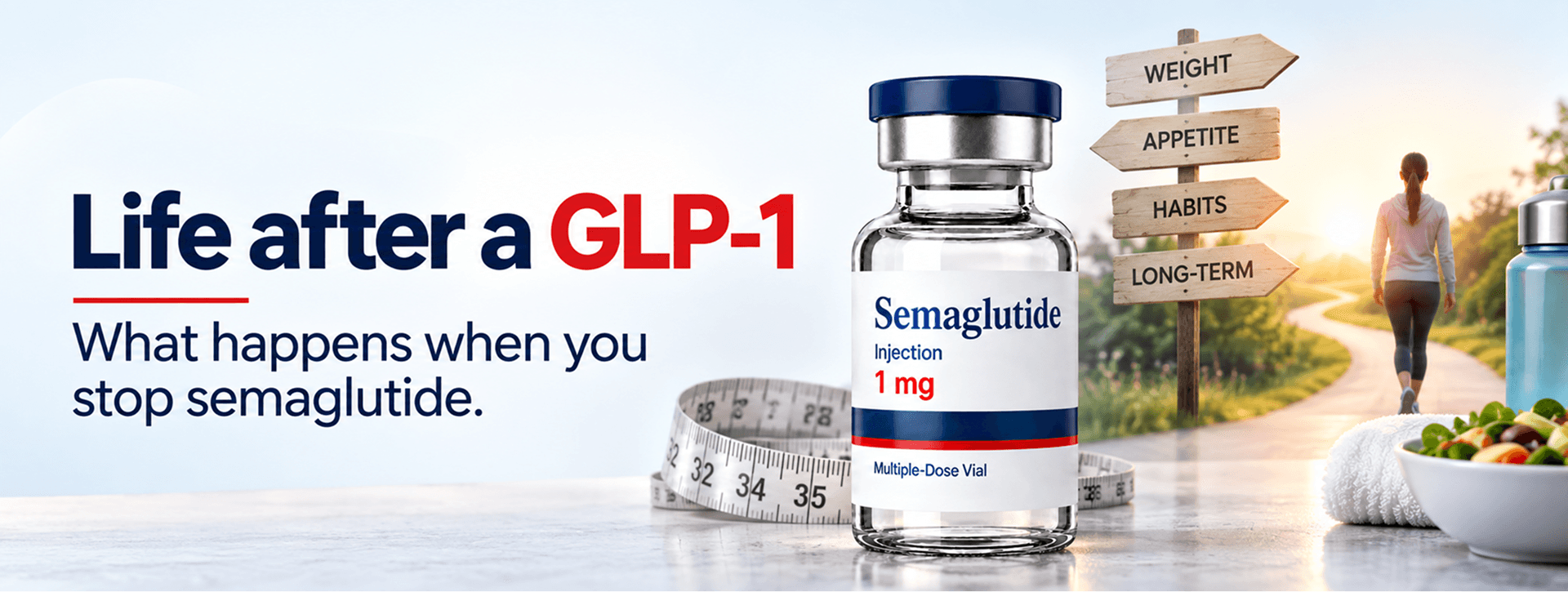
When you stop a GLP-1, appetite usually returns and some weight often comes back. That's physiology, not failure. Options include staying on a lower maintenance dose, stepping down gradually, or stopping with a structured food and training plan. Your prescriber decides what fits your case.
What happens when you stop semaglutide
The appetite quiet gets loud again. That's the part patients describe first, usually within a few weeks, and it catches people off guard because they'd started to think of the reduced hunger as their new normal.
The medication doesn't rewire hunger permanently. It occupies a receptor pathway while it's in your system, and when it clears, the signalling goes back to roughly what it was. Some of the weight tends to follow. How much and how fast varies a great deal between people, and the published figures depend heavily on whether patients had any structured support after stopping.
Here's the framing that helps most people: this is how chronic conditions behave. Nobody is surprised when blood pressure climbs after someone stops their blood-pressure medication, and nobody calls that a character flaw. Weight regulation works the same way. You didn't fail. The treatment stopped, so the treatment effect stopped.
The three exits people actually take
- Stay at your treatment dose — no change once you hit your goal. Main trade-off: ongoing cost and ongoing side-effect exposure, however mild.
- Step down to a lower ongoing dose — provider reduces to the lowest dose that holds the result. Main trade-off: some appetite return; may need adjusting more than once.
- Stop entirely — medication ends; food and training habits carry the result. Main trade-off: highest regain risk, especially without a plan in place first.
None of these is the correct answer. The right one depends on why you started, what your weight has been doing for the last three months, what else you're being treated for, and frankly what you can afford. Have that conversation before you're at the decision point, not after.
What tapering does and doesn't do
Tapering off a GLP-1 is not like tapering off a medication with a withdrawal syndrome. You're not preventing a physical crash. What a gradual step-down does is give you a chance to see what happens at each level, so you find the smallest dose that still holds your result instead of guessing.
That's the real argument for it. You learn something at every step.
There is no universal taper schedule, and you will not find your own in an article — including this one. Pace depends on your dose, how long you've been on it, how stable your weight has been and what else is going on medically. That's prescriber territory.
The habits that carry the result
Whatever route you take, the same short list does the heavy lifting after treatment intensity drops.
- Protein and fiber, kept up deliberately. Once appetite returns, the meals that were satisfying at 1,400 calories won't be. Building meals around protein and fiber buys you fullness you no longer get for free.
- Resistance training, two or three times a week. Lean mass is what keeps your resting energy use from sagging as you lose weight. It's also the thing you'll want back if you regain some fat.
- A weighing rhythm you'll actually keep. Weekly, same day, same conditions. The point isn't the number, it's catching a four-pound drift before it becomes twenty.
- A pre-agreed line. Decide in advance what number, or what change in how your clothes fit, means you call your provider. People who set that line before they stop tend to act on it. People who don't tend to wait, then feel too embarrassed to come back.
Cost is quietly part of the clinical plan
A lot of people don't choose to stop. They stop because month four cost twice what month one did.
Online GLP-1 programs in 2026 run roughly $99 to $348 a month, and almost all of them escalate with dose. That structure creates a nasty incentive: the moment you reach an effective dose, your bill jumps, and stopping starts to look sensible for reasons that have nothing to do with medicine. The GLP Doctor charges $149 a month at any dose, with no membership fee, so a maintenance decision stays a clinical one.
Supply matters too. FDA declared the tirzepatide shortage resolved on 2 October 2024 and the semaglutide shortage on 21 February 2025, which changed the compounding landscape and left some patients with unplanned interruptions. An unplanned stop is still a stop. If your supply is about to lapse, tell your provider before it does.
Does the oral option change any of this?
It changes convenience more than physiology. Oral semaglutide 25 mg was FDA-approved on 22 December 2025, and orforglipron — marketed as Foundayo — followed on 1 April 2026, with no food or water timing restrictions. A daily tablet is easier to keep taking than a weekly injection for some people, and easier to forget for others. Either way, the underlying point holds: stop the medicine, and the medicine stops working.
When stopping is the right call
Sometimes it plainly is. Side effects you're not willing to live with. Pregnancy plans. A new diagnosis that changes the calculation. Reaching a weight you're happy with and wanting to test whether you can hold it. All legitimate.
Nobody can tell you in advance how much you'll keep. What's fair to say is that people who plan the exit hold on to more than people who simply run out of medication on a Tuesday.
Frequently asked questions
How fast does weight come back?
Usually gradually rather than overnight, tracking the return of appetite over the weeks after your last dose. Individual results vary widely.
Do I have to take this forever?
Not necessarily, and that's a genuinely unsettled question in the field. Many clinicians treat obesity as a long-term condition and expect long-term management of some kind, which may or may not be medication.
Is stopping abruptly dangerous?
It isn't generally considered dangerous the way stopping some other medicines can be. Tell your prescriber anyway, particularly if you take medication whose effect changes with your food intake.
Can I restart later?
Yes, and plenty of people do. Expect a fresh evaluation and a restart at a lower dose rather than picking up where you left off.
Will the side effects come back if I restart?
Possibly. Reintroduction often brings back early nausea, which is one reason providers restart low.
About this guide
Treatment is prescription-only and follows a medical evaluation with a licensed provider. Not everyone is eligible. Compounded medications are not FDA-approved and are not reviewed by FDA for safety, effectiveness or quality. Wegovy, Ozempic, Zepbound, Mounjaro and Foundayo are trademarks of their respective owners, used here descriptively.
This article is general information, not medical advice, and it can't account for your history. Do not start, change or stop any prescription medication based on something you read online — talk to your prescriber.